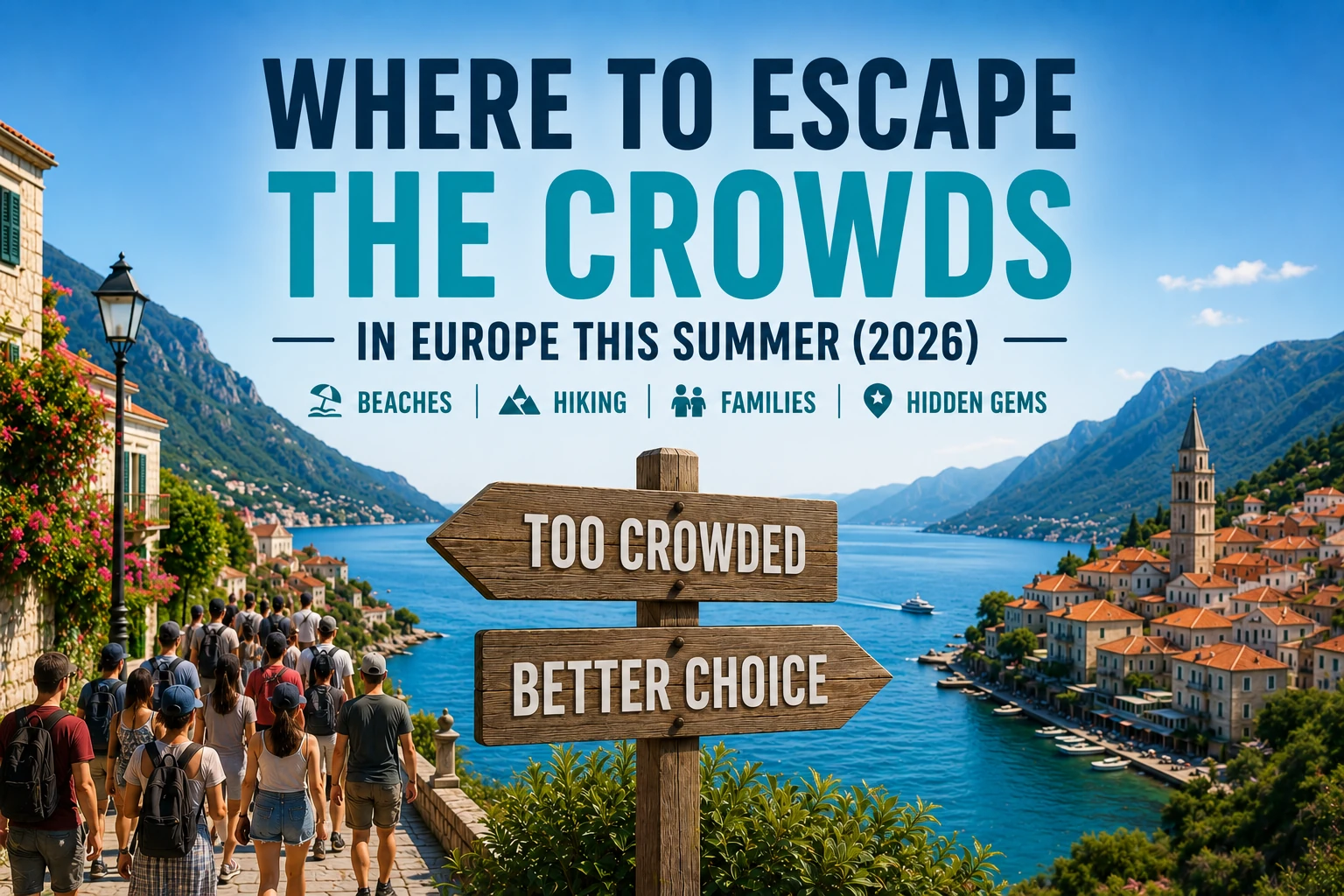
Where to Escape the Crowds in Europe This Summer (2026)
Summer is the most popular travel season in Europe, and for good reason. Warm weather, long days, festivals, beaches, and school holidays bring millions of travelers across the continent every year.
Unfortunately, they often end up in the same places.
The result? Long queues, packed beaches, crowded attractions, expensive accommodation, and an experience that often looks very different from the dream holiday people imagined.
That's exactly why we created the Overtourism Index (OTI) at WhisperingPlaces.
The OTI rates destinations on a scale from 0 to 5, where:
0–1: Very quiet
1–2: Light tourism
2–3: Moderate tourism
3–4: Busy
4–5: Highly crowded
The score takes into account factors such as tourism popularity, seasonal demand, destination size, accommodation pressure, visitor concentration, and known crowding patterns during the selected travel period.
If you're planning a summer trip in 2026, here are ten popular destinations where crowds are likely to be significant, and ten alternatives that offer a more relaxed experience.
1. Santorini, Greece
Santorini, Greece
OTI: 4.8 / 5Santorini remains one of Europe's most iconic destinations, but its popularity creates serious summer pressure. The island is small, and most visitors concentrate around the same viewpoints, sunset spots, cliffside villages and cruise arrival areas.
In July and August, the experience can quickly feel crowded: narrow streets fill up, restaurants require early booking, viewpoints become packed and prices rise sharply. This is why Santorini receives a very high OTI score for peak summer.
Naxos, Greece
OTI: 2.5 / 5Naxos offers beautiful beaches, traditional villages, excellent food, and authentic Greek island charm, without the overwhelming crowds.
2. Venice, Italy
Venice, Italy
OTI: 4.9 / 5Venice is one of Europe's clearest examples of high tourism pressure. The historic center is compact, walkable and fragile, which means even moderate visitor numbers can feel intense.
During summer, day-trippers, cruise-related traffic, hotel guests and cultural sightseeing all concentrate in the same narrow streets, bridges and squares. The result is one of the highest OTI scores in Europe.
Trieste, Italy
OTI: 2.8 / 5Trieste offers elegant architecture, seaside charm, excellent cafés, and a much more relaxed atmosphere. It still feels like a real city, not just a tourist attraction.
3. Dubrovnik, Croatia
Dubrovnik, Croatia
OTI: 4.8 / 5Dubrovnik's old town is beautiful but very limited in size. Its popularity, cruise arrivals and peak summer demand create strong crowd concentration inside the historic walls.
Even if the wider region has quieter areas, the main tourist experience often happens in a small number of streets, viewpoints and waterfront locations. That makes Dubrovnik feel heavily crowded in July and August.
Perast, Montenegro
OTI: 2.1 / 5Located on the Bay of Kotor, Perast offers stunning scenery, historic buildings, calm waterfront walks and a far quieter experience than Dubrovnik.
4. Cinque Terre, Italy
Cinque Terre, Italy
OTI: 4.6 / 5Cinque Terre has five small villages connected by limited transport routes and narrow walking paths. This makes the area especially sensitive to crowd pressure.
In summer, visitor numbers often exceed what the villages can comfortably absorb. Train stations, trails, viewpoints and waterfront areas can feel congested, which explains the high OTI score.
Camogli, Italy
OTI: 2.4 / 5Camogli provides colorful seaside beauty, excellent seafood, and a more authentic Italian Riviera atmosphere, while feeling far less overwhelming than Cinque Terre.
5. Amalfi Coast, Italy
Amalfi Coast, Italy
OTI: 4.6 / 5The Amalfi Coast combines extreme popularity with limited space. Its roads, villages and coastal viewpoints were never designed for the level of summer tourism they now receive.
During peak season, traffic, parking problems, crowded buses, expensive accommodation and packed towns can make the experience stressful, especially around Positano, Amalfi and Ravello.
Lecce, Italy
OTI: 2.3 / 5Lecce combines beautiful Baroque architecture, excellent food, a warm southern Italian atmosphere and easy access to beaches while receiving far fewer visitors than the Amalfi Coast.
6. Barcelona, Spain
Barcelona, Spain
OTI: 4.5 / 5Barcelona is a large city, but tourism is heavily concentrated in a few famous areas such as the Gothic Quarter, La Rambla, Sagrada Família, Park Güell and the beach zones.
In summer, this concentration creates strong pressure on public transport, restaurants, accommodation and local neighborhoods. The city can still be enjoyable, but the main tourist routes often feel very busy.
Valencia, Spain
OTI: 3.0 / 5Valencia offers beaches, culture, nightlife, green urban spaces and outstanding food with noticeably lower visitor pressure than Barcelona.
7. Mykonos, Greece
Mykonos, Greece
OTI: 4.7 / 5Mykonos has become one of the Mediterranean's most fashionable summer destinations. Its beach clubs, nightlife, luxury hotels and social media popularity create very high seasonal demand.
The island is not large enough to absorb this pressure evenly. In July and August, prices rise sharply, popular beaches become crowded and the atmosphere can feel more exclusive and intense than relaxed.
Paros, Greece
OTI: 2.8 / 5Paros offers charming villages, excellent beaches, Cycladic architecture and a more balanced tourism environment than Mykonos.
8. Hallstatt, Austria
Hallstatt, Austria
OTI: 4.7 / 5Hallstatt is a small village with global fame. Its beauty attracts huge numbers of visitors, but the village itself has very limited space.
This creates one of the clearest cases of tourism concentration in Europe. Even when visitor numbers are not enormous compared with big cities, the small size of Hallstatt makes the crowd impact feel much stronger.
Bad Ischl, Austria
OTI: 2.2 / 5Bad Ischl offers mountain scenery, historic charm, imperial architecture, relaxed cafés and a much more comfortable pace than Hallstatt.
9. Amsterdam, Netherlands
Amsterdam, Netherlands
OTI: 4.3 / 5Amsterdam remains one of Europe's most visited city destinations. Its canals, museums, nightlife and historic center attract heavy visitor traffic throughout the year.
In summer, crowd pressure becomes especially visible around the central canal belt, museum areas, station district and nightlife zones. The city is larger than Venice or Hallstatt, so the OTI is slightly lower, but still clearly busy.
Utrecht, Netherlands
OTI: 2.7 / 5Utrecht delivers canals, history, cafés, student energy and Dutch atmosphere without the same level of tourism pressure as Amsterdam.
10. Capri, Italy
Capri, Italy
OTI: 4.7 / 5Capri receives very strong summer demand from day-trippers, luxury travelers and visitors coming from Naples, Sorrento and the Amalfi Coast.
Because the island is small, tourism pressure concentrates around the harbor, viewpoints, boat tours, shopping streets and famous natural sights. In peak season, the experience can feel crowded, expensive and highly compressed.
Ischia, Italy
OTI: 2.9 / 5Ischia combines beaches, thermal spas, nature, local food and a more lived-in island atmosphere while generally feeling less crowded than Capri.
Why Overtourism Matters
Crowding is not only about inconvenience.
Higher tourism pressure often leads to:
• Longer queues
• More traffic
• Higher accommodation prices
• Reduced availability
• Less authentic local experiences
• Greater environmental pressure
How WhisperingPlaces Uses OTI
The Overtourism Index (OTI) helps travelers understand how crowded a destination is likely to feel during a specific travel period.
Rather than simply measuring popularity, the index considers how visitor numbers interact with destination size, tourism infrastructure, and seasonal demand.
The goal is simple:
Help travelers make better decisions, avoid unnecessary crowds, and discover places that offer a more enjoyable experience.
Because sometimes the best trip isn't the destination everyone talks about, it's the one that still has room to breathe.