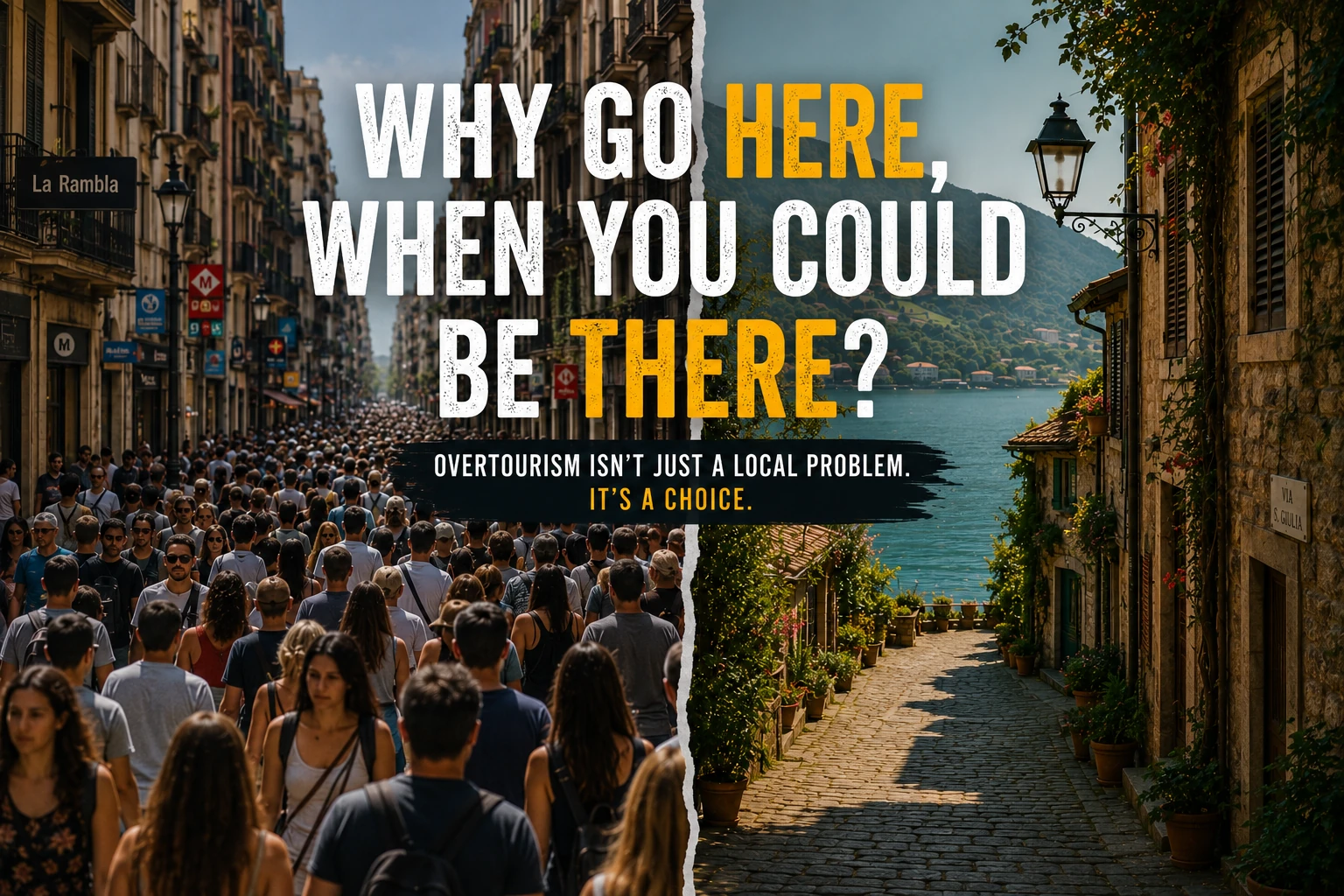
Travel used to feel different
Travel used to feel like discovery.
It was about slowing down, wandering through unfamiliar streets, finding hidden corners and experiencing something real.
But in many of the world’s most famous destinations, that feeling is slowly disappearing.
Instead of peaceful beaches, travelers find overcrowded coastlines. Instead of charming old towns, they find endless queues, noise, traffic and streets packed shoulder to shoulder.
And while tourists often leave feeling disappointed, locals are the ones living with the consequences every single day.
The problem is not tourism itself.
The problem is that millions of people are being pushed toward the exact same places at the exact same time.
What overtourism feels like for locals
When people think about overtourism, they usually imagine crowded beaches, long queues or packed city centers.
But for locals, the impact goes much deeper than inconvenience.
In many popular destinations, tourism is no longer just part of the economy, it has started to reshape everyday life.
Housing becomes unaffordable
One of the biggest problems is the housing market.
As short-term rentals and tourist apartments become more profitable, more and more homes disappear from the long-term rental market.
In some cities, locals are no longer competing with their neighbors for apartments, they are competing with the global tourism industry.
Rents rise. Property prices explode. Young people are forced to move farther away from the places where they grew up.
Some historic city centers slowly turn into places made almost entirely for visitors.
Cities start functioning for tourists instead of residents
Over time, local businesses also begin to change.
Small grocery stores, family-owned shops and everyday services disappear, replaced by souvenir stores, luxury apartments and tourist-focused restaurants.
The city may still look beautiful from the outside, but daily life becomes harder for the people who actually live there.
Even basic things like public transport, parking or going to the supermarket can become stressful during peak season.
Infrastructure struggles under the pressure
Many destinations were never designed to handle millions of visitors every year.
Roads become overloaded. Public transport gets crowded. Waste management systems struggle. Water usage increases dramatically during summer months.
In smaller coastal towns or islands, the pressure can become especially visible.
Places built for a few thousand residents suddenly have to function like major global tourist hubs.
And eventually, the atmosphere changes
Perhaps the saddest part is that many locals begin to feel disconnected from their own city.
Neighborhoods become temporary. Traditional places disappear. Daily life starts revolving around visitor demand instead of local culture.
And ironically, this also affects travelers.
Because the more a destination turns into a tourist machine, the more it loses the authentic atmosphere people originally came for.
Travelers are losing the magic too
Overtourism does not only hurt locals.
It also changes the travel experience itself.
Many people spend years dreaming about a destination, saving money and planning the perfect trip, only to arrive and spend most of their vacation surrounded by crowds.
Hours are lost standing in queues. Beaches feel packed. Restaurants become rushed and overpriced. Famous viewpoints turn into photo lines.
Sometimes we spend thousands on a dream trip, only to stand in crowds the entire time.
Most travelers are not actually searching for crowds.
They are searching for beauty, atmosphere, peace, culture and memorable experiences.
But mass tourism often pushes everyone toward the exact same destinations, creating the very thing people wanted to escape from.
The world has more than ten destinations
The good news is that the world is still full of incredible places.
Quiet coastal towns. Hidden islands. Underrated mountain villages. Smaller cities with beautiful architecture, amazing food and authentic local culture.
And unlike the world’s most overcrowded hotspots, many of these places genuinely welcome new visitors.
Tourism can bring opportunities, support local businesses and help smaller destinations grow sustainably, when it is spread more evenly.
Choosing alternative destinations does not mean giving up beautiful experiences.
In many cases, it leads to better ones.
Less stress. More authenticity. More connection. More room to actually enjoy the place you traveled so far to see.
Maybe smarter travel is the future
Travel is not the enemy.
People will always want to explore the world, and that is a beautiful thing.
But perhaps the future of travel is not about squeezing more people into the same famous locations.
Perhaps it is about discovering quieter places, traveling more thoughtfully and spreading tourism beyond the usual hotspots.
Because sometimes the most unforgettable experiences are found in the places nobody told you about yet.